
Introduction: From Blank Room to Immersive World
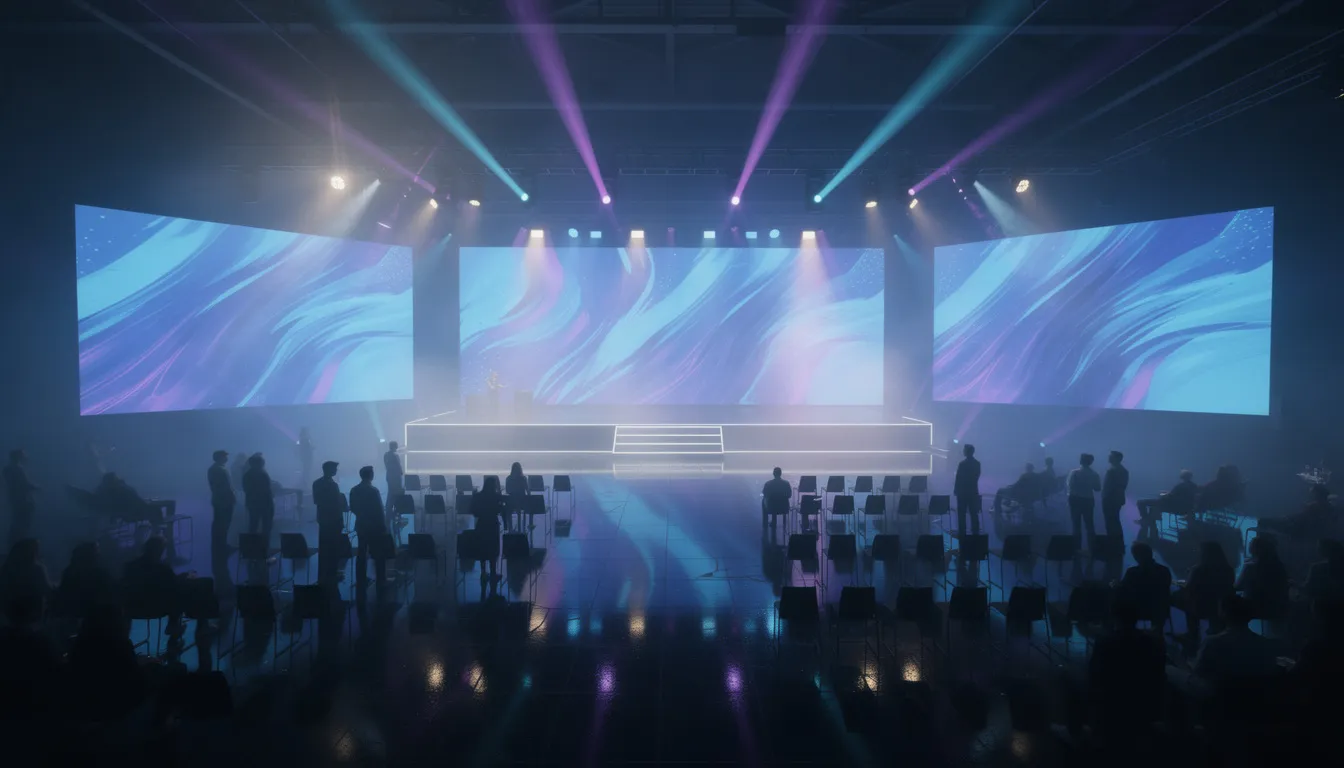
Picture a standard hotel ballroom in Glasgow, beige walls, low ceilings, corporate carpet. Now imagine that same space transformed: floor-to-ceiling LED video walls displaying a dynamic cityscape, architectural lighting sculpting the room in deep blues and golds, a custom soundscape building anticipation as guests arrive, and every surface wrapped in brand messaging that tells a story. This is what we delivered for a technology product launch in 2024, turning an unremarkable venue into a fully branded, multisensory experience that guests talked about for months.
An immersive environment in live events isn’t just about technology, it’s about creating a sense of presence, where attendees feel transported into a world rather than simply observing a presentation. It combines storytelling that unfolds across the guest journey, interactivity that invites participation rather than passive viewing, and multisensory design that engages sight, sound, touch, and even smell. While immersive technology like virtual reality headsets and head mounted displays have their place, most corporate events achieve immersion through carefully orchestrated lighting, audio, video, staging, and content, no VR environment required.
This article is written by Sonus Events, a Glasgow-based full-service event production and AV company working across the UK and Europe. We specialise in designing, building, and delivering immersive experiences for corporate conferences, brand activations, product launches, exhibitions, awards nights, and private events. Our core services, AV hire, lighting, LED video walls, stage and set design, event management, and hybrid event production, form the toolkit that turns any physical space into an immersive journey.
If you’re a corporate event planner, agency, brand, or in-house team looking to move beyond standard presentations and create environments that captivate, this guide is for you. We’ll walk through a step-by-step approach from concept to delivery, with practical tips, examples from 2023–2025 UK events, and insights into where a production partner like Sonus Events adds value. By the end, you’ll understand how to turn your next conference, awards dinner, or launch into something extraordinary.
1. Start with Purpose: Why You’re Making the Venue Immersive
Before selecting a single LED panel or designing a lighting look, you need to answer a fundamental question: why are you creating an immersive experience in the first place? Immersion without purpose becomes spectacle without substance, visually impressive but strategically empty. The most effective immersive environments serve clear business and communication objectives.
Every immersive environment should trace back to measurable goals. A 2025 tech launch in London might focus on product recall and social media amplification. A Glasgow financial conference might prioritise engagement metrics and delegate satisfaction. A 2024 charity gala in Edinburgh might aim for emotional impact that drives donations. These different purposes demand different approaches to immersion, from the technologies deployed to the narrative structures employed.
Here’s how to establish purpose before production:
- Define 2–3 measurable goals before selecting any technology. These might include dwell time in an experience zone, social media shares with event hashtags, lead capture numbers from interactive installations, or post-event survey scores. Without metrics, you can’t prove ROI.
- Match immersive intent to event type. Education-focused events (training delegates on a new medical device, for instance) require immersion that supports learning and retention. Emotional impact events (charity galas, memorial dinners) need immersive elements that heighten feeling. Entertainment-focused events (Christmas parties, summer festivals, live music celebrations) prioritise spectacle and energy.
- Map business objectives to audience journeys. Consider how immersion supports each phase: arrival and registration (first impressions, brand orientation), main show (key messages, climactic moments), breakout sessions (focused engagement, networking), and post-event follow-up (memory anchors, social sharing opportunities).
- Align with brand values. A sustainability-focused brand shouldn’t deploy an energy-intensive immersive setup without considering the message it sends. A luxury brand needs production values that match its positioning.
At Sonus Events, we typically begin with a discovery session that explores brand values, key messages, target demographics, venue constraints, and budget bands. This ensures every production decision, from the pixel pitch of the LED walls to the colour temperature of the lighting – serves the strategic purpose rather than simply looking impressive.
2. Reading the Room: Assessing and Choosing the Right Venue
Almost any space can become an immersive environment with the right approach. We’ve transformed hotel ballrooms in Edinburgh, warehouses in Manchester, university lecture theatres in Glasgow, and marquees in the Highlands. But each venue type presents unique opportunities and constraints that shape what’s possible – and practical – for your immersive build.
The venue you choose (or are given) determines much of your technical approach. A black-box studio offers maximum flexibility but minimal character. A heritage building offers atmosphere but strict limitations. Understanding these trade-offs early prevents expensive redesigns later.
Key physical factors to assess during venue selection or initial site visits:
- Ceiling height. This determines whether you can fly lighting truss, rig large LED walls, or create overhead installations. A 3-metre ceiling limits options significantly; 6 metres or more opens up dramatic possibilities.
- Power availability. Immersive productions draw significant power. Know the venue’s supply capacity, distribution board locations, and whether three-phase power is available. Budget for temporary power if the venue supply is insufficient.
- Rigging points. Check for structural rigging points in the ceiling grid. Without them, you’ll need ground-supported truss or alternative solutions, which affect floor space and sightlines.
- Load-in access. Is there a loading bay? Are there any obstructions? What’s the route from truck to event space? These logistics affect build time and crew costs.
- Noise limits and neighbourhood restrictions. Late-night events may face sound curfews. Venues in residential areas may restrict bass levels or outdoor amplification.
- Fire exits and evacuation routes. Immersive builds cannot obstruct emergency egress. Build plans must accommodate clear routes and emergency lighting requirements.
Venue types that work particularly well for immersive builds in the UK include black-box studios (maximum control, minimal constraints), exhibition halls like SEC Glasgow (high ceilings, strong power, purpose-built infrastructure), converted industrial spaces around London’s Docklands and royal victoria dock area (atmospheric backdrops, flexible layouts), and railway arches in Leeds or Manchester (unique character, acoustic challenges to manage).
We recommend walking the space at the same time of day as your event to judge natural light, ambient noise, and neighbourhood activity. What seems quiet at midday may face rush-hour traffic noise at 6pm.
Sonus Events can support venue sourcing with 3D visualisations and layout plans that demonstrate immersive potential at proposal stage, helping you secure stakeholder buy-in before committing to a space.
3. Designing the Story: Concept, Narrative and Guest Journey
The most memorable immersive environments tell a story. Not necessarily a literal narrative with characters and plot, but a structured journey that creates meaning and emotional arc across the event. This story spine is the backbone of immersion, it gives every technical decision a purpose and ensures the guest experience feels coherent rather than chaotic.
Think of your event as a piece of immersive content with a beginning, middle, and end. Guests arrive as participants in this story, and every element – from the lighting in the foyer to the final moment of the afterparty – should contribute to the narrative arc. This approach transforms scattered production elements into a unified immersive experience.
Structuring your story spine:
- Beginning (arrival and orientation). The journey starts before guests enter the main space. How does the foyer introduce the world? What sensory cues – lighting, sound, visual information – establish the tone? This is where you set expectations and build anticipation.
- Middle (reveal, interaction, climax). The main event space delivers the core experience. This might include dramatic reveals (a product unveiled as LED walls part), interactive moments (guests influence content through their actions), and a climactic peak (the award announcement, the keynote conclusion, the entertainment finale).
- End (resolution, call to action, memory anchor). How does the experience conclude? What’s the final sensory impression? Strong endings create lasting memories and drive post-event actions – whether that’s social sharing, lead submission, or emotional commitment to a cause.
Concrete thematic examples from recent UK events:
- A 2026 sustainability summit using a “journey from grey to green” visual narrative, guests arrive in a monochrome environment that gradually introduces colour and natural imagery as the programme progresses, culminating in a vibrant finale celebrating solutions.
- A fashion show in 2025 with a “future city” storyline where LED environments created an evolving urban landscape, shifting from dawn to neon-lit night across the show’s three acts.
- A product launch structured as “exploration of a new world” where guests moved through themed zones, each revealing different product features, before converging for the main reveal.
To develop your narrative, map the physical journey: foyer, registration, pre-function, main room, bar or afterparty. Each space should play a role in the story. Use consistent visual language – colours, typography, motion graphics, and scenic elements – that appears across LED walls, printed décor, and lighting looks. Integrate live moments through choreographed lighting cues, timed content on LED walls, and sound design stings that punctuate key announcements.
Sonus Events’ creative team develops moodboards, 3D renders, and content briefs that translate brand strategy into cohesive immersive concepts – ensuring your story spine informs every production decision.
4. Sensory Layers: Light, Sound, Video and Set as Your Core Tools
This is your toolkit for immersion. While computer science continues to develop sophisticated virtual environments and digital world applications, most corporate events achieve immersion through the masterful orchestration of four core elements: lighting, sound, video, and staging. These sensory layers work together to create physical environments that feel alive, purposeful, and emotionally resonant.
Understanding how each layer contributes – and how they interact – is essential for designing immersive environments that deliver on your strategic goals.
Lighting
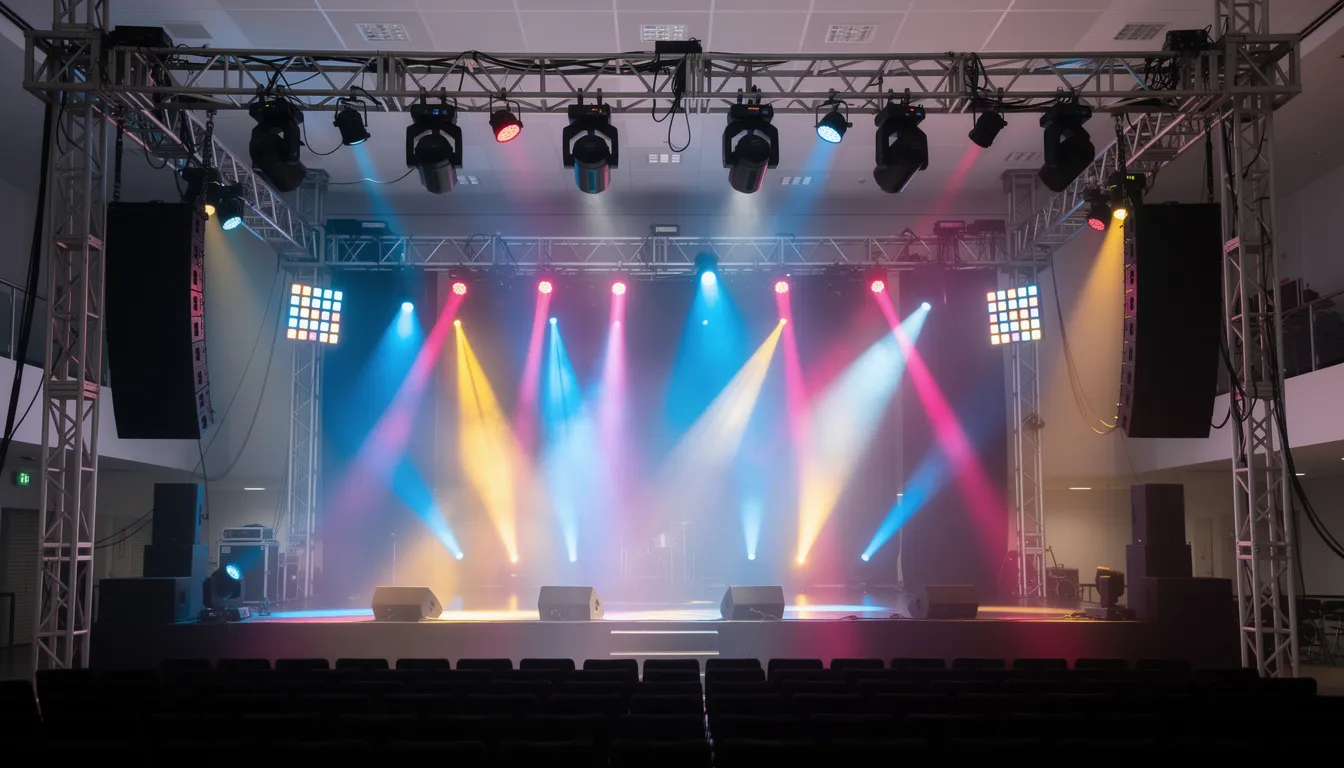
Lighting is the most powerful tool for transforming a space. It sculpts architecture, directs attention, establishes mood, and supports narrative progression throughout the event.
- LED fixtures and moving heads allow dynamic control – changing colours, intensities, and positions throughout the event to match programme beats.
- Pixel-mapped effects turn lighting arrays into visual canvases, creating waves, pulses, and patterns that respond to music or presenter cues.
- Practical applications. At a 2024 Edinburgh awards show, we used colour transitions to guide mood across the evening – cool blues for the formal opening, warm ambers during dinner, dynamic colours for the awards sequence, and celebratory washes for the afterparty.
- Gobos project textured patterns or logos, adding depth and brand presence without additional screens.
- Architectural lighting for corridors, bars, and pre-function spaces extends immersion beyond the main room.
Sound
Audio creates atmosphere, enhances emotional impact, and – in conference settings – ensures content is heard clearly. Immersive audio goes beyond amplification to become a design element in its own right.
- Distributed speaker layouts wrap sound around audiences rather than projecting from a single point, creating spatial audio experiences.
- Low-level ambient soundscapes in pre-function areas establish mood before guests enter the main space, nature sounds for a wellness brand, urban textures for a technology company, or curated playlists that reflect brand identity.
- Speech clarity remains paramount for conferences and presentations. Immersive sound design must enhance rather than compete with content.
- Reactive audio cues linked to stage content, stings for award announcements, builds for reveals, transitions for scene changes, heighten dramatic impact.
- 360° soundscapes for brand activations create truly enveloping experiences. We’ve deployed these in London pop-up venues to simulate environments from rainforests to space stations.
LED Video Walls
Large-format LED creates visual environments that projectors can’t match, brighter, more vivid, and visible in ambient light. LED walls can wrap a stage, create portals into other worlds, or simulate environments from cityscapes to forests.
- Pixel pitch determines resolution at viewing distance. For 2024–2026 indoor conferences and awards where audiences view from 3–10 metres, 2.6mm to 3.9mm pitch delivers sharp imagery.
- Configuration options include traditional stage backdrops, wrap-around environments, overhead canopies, and floor integration for 360-degree immersion.
- Content considerations. LED walls are only as good as the content displayed. Generic stock footage undermines the investment; bespoke motion graphics aligned to brand and narrative maximise impact.
Projection and Mapping
Projection offers alternatives where LED isn’t practical – heritage venues where walls can’t be physically altered, or temporary installations where LED infrastructure isn’t justified.
- Projection mapping animates building features, scenic flats, or custom structures, turning static surfaces into dynamic canvases.
- Multi-projector blends create panoramic environments on curved or irregular surfaces.
- Limitations. Projection requires controlled ambient light. Bright venues or daytime events may need blackout solutions.
Stage and Set
Scenic elements complete the transformation from venue to world. Custom staging turns a generic room into a specific environment – a 1930s jazz club, a futuristic control room, a natural forest glade.
- Risers and platforms create visual hierarchy and improve sightlines.
- Scenic facades disguise venue architecture and reinforce thematic environments.
- Dimensional elements, columns, archways, sculptural forms – add depth and photo opportunities.
- Materials and finishes contribute to perceived quality. Even with spectacular technology, cheap-looking scenic elements undermine immersion.
Sonus Events offers integrated lighting, audio, LED, projection, and staging packages, ensuring all systems are designed together rather than in isolation. This integrated approach creates cohesive immersive environments where every element reinforces the others.
5. Adding Depth: Interactivity, Technology and Hybrid Participation
Visual spectacle creates atmosphere, but interactivity creates engagement. When users interact with an environment – when their user’s actions influence what they see and hear – immersion deepens from observation to participation. This is where immersive environments move beyond decoration to become genuine interactive experiences.
Modern event technology offers numerous ways to create these participatory moments, from simple smartphone apps to sophisticated sensor networks. The key is selecting technologies that serve your objectives rather than deploying technology for its own sake.
Audience Interaction
- Live polling and Q&A apps let audiences influence content in real time, creating immediate feedback loops between presenters and participants.
- Interactive light responses to crowd noise – cheering triggers colour changes or intensity builds – create collective participation moments.
- Gamified activities spread across the venue encourage exploration and increase dwell time in key zones. Leaderboards displayed on LED screens drive competitive engagement.
Sensors and Triggers
- Motion sensors trigger content on LED screens or audio cues as guests move through zones, creating a sense that the environment responds to presence.
- RFID badges track movement and enable personalised experiences – welcome messages, tailored recommendations, or content unlocks based on attendee type.
- QR codes offer low-tech interactivity that works with any smartphone, linking to augmented reality experiences, additional content, or data collection forms.
AR and Mixed Reality
- Augmented reality filters tied to product launches let guests visualise products in context or access hidden content through ar apps on their devices.
- AR-enhanced exhibition stands at trade shows like those at NEC Birmingham in 2025 create memorable interactions without requiring ar devices beyond attendees’ own phones.
- Mixed reality experiences that blend virtual objects with physical environments offer premium engagement for key guests or VIP experiences.
- Smart glasses and ar headset applications remain emerging technologies for events, though london offers several venues experimenting with these formats, including outernet london near tottenham court road and locations around charing cross road.
Hybrid Events
For events with remote participants, designing the venue so online attendees feel immersed is essential:
- Multi-camera setups capture presenter and audience energy, avoiding the static single-shot that makes virtual attendees feel disconnected.
- Dedicated LED backdrops for presenters create visual environments visible on camera, extending the immersive environment to the virtual space.
- Return feeds of chat and polls visible in the room create connection between in-person and online audiences.
- Eye tracking and head position analysis in advanced setups can optimise camera angles for maximum engagement.
Accessibility
Immersive and interactive elements must be inclusive:
- Clear signage and alternative input devices ensure guests with different abilities can participate fully.
- Captioning for streams makes hybrid content accessible to deaf and hard-of-hearing participants.
- Quiet zones offer respite for guests who find intense sensory environments overwhelming.
- Privacy concerns around data collection must be addressed transparently, with clear opt-in processes.
Sonus Events provides technical direction, streaming infrastructure, and content workflows that integrate in-venue immersion with platforms like Vimeo, YouTube Live, or corporate webcast tools – ensuring your immersive experience reaches every attendee, wherever they are.
6. Practical Build: Logistics, Safety and Running an Immersive Show
Ambitious creative visions must translate into safe, deliverable productions. The most spectacular immersive concept means nothing if it can’t be built within the load-in window, powered reliably, or operated safely throughout the event. This is where production experience separates successful immersive events from stressful disasters.
Immersion must remain safe and deliverable. Here’s how to make that happen:
Pre-Production
- Create detailed CAD plans and 3D visualisations showing lighting positions, LED configurations, scenic elements, and audience flow. These documents align all stakeholders on what’s being built.
- Computer aided design tools allow precise planning of technical elements, ensuring equipment fits the space and sightlines work from all audience positions.
- Lock designs 8–10 weeks before a 500-delegate conference to allow equipment sourcing, content creation, and supplier coordination. Larger or more complex builds need longer.
- Schedule pre-production meetings at key milestones to review progress, address challenges, and confirm decisions with all parties.
Load-In and Build
- Typical builds for a full-scale awards night with flown LED walls in a UK hotel ballroom require 1–2 days of load-in, depending on complexity.
- Coordinate with venue management on load-in schedules, access times, and any venue-specific requirements (union crew, house systems integration, noise restrictions during setup).
- Build sequences matter – rigging and lighting first, then LED and video, then scenic and staging, then fine tuning and focusing.
Power and Infrastructure
- Calculate power requirements accurately. LED walls, lighting fixtures, audio systems, and content servers all draw significant power. Underestimating leads to trips and failures.
- Distribution plans ensure power reaches all equipment positions safely. Cable routing must avoid trip hazards and maintain emergency egress routes.
- Backup strategies for critical systems – redundant playback, backup cables, spare fixtures – prevent single points of failure from derailing the event.
Health and Safety
- Structural sign-off for flown truss and suspended LED walls, typically requiring calculations from a structural engineer and venue approval.
- Emergency lighting must remain functional throughout – immersive environments can’t compromise safety in an evacuation.
- Egress routes must be kept clear at all times, with clear signage visible even in low-light immersive scenarios.
- Haze and special effects require careful management – haze triggers fire alarms unless detectors are isolated, and effects must comply with venue policies and UK regulations.
Rehearsals
- Full technical run-throughs test every cue, transition, and interactive element before guests arrive.
- Cue-to-cue rehearsals with presenters and performers ensure everyone understands their marks, timings, and technical cues.
- Camera rehearsals for hybrid events verify framing, lighting for camera, and content display on stream.
Showcalling
- A central showcaller coordinates lights, sound, video, and stage action, especially in complex immersive sequences where multiple elements must synchronise precisely.
- Stage management teams support showcalling with cueing, artist management, and real-time problem solving.
- Communication systems (headsets, cue lights) keep all crew aligned throughout the show.
De-Rig and Sustainability
- Efficient de-rigging minimises venue overtime charges and crew costs. Plan the reverse sequence as carefully as the build.
- Waste minimisation through reusable scenic elements, recyclable materials, and energy-efficient LED and lighting equipment meets 2025 sustainability expectations.
- Document setups for future events – what worked, what didn’t, and how to improve next time.
Sonus Events offers end-to-end project management – technical drawings, crew, logistics, and showcalling – across UK and European venues. We ensure designs are realistic as well as ambitious, turning creative visions into flawless executions.
7. Budgets, Timelines and Working with an AV Production Partner
Immersive environments represent significant investments, but they don’t have to break budgets when planned strategically. Understanding cost drivers, realistic timelines, and how to work effectively with production partners ensures you maximise impact within your constraints.
Budgets
Cost drivers for immersive events include:
- Room size determines the scale of lighting, audio, and scenic coverage required.
- LED surface area is a significant cost factor – larger walls or wrap-around configurations increase both hire and content creation costs.
- Complexity of lighting from basic wash lighting to sophisticated pixel-mapped arrays varies dramatically in cost.
- Custom set builds versus off-the-shelf staging elements affect scenic budgets.
- Interactive technology adds layers of cost for hardware, software development, and technical operation.
- Comparison examples. A small 150-guest immersive dinner with focused lighting, modest LED, and atmospheric sound costs significantly less than a 1,000-delegate awards show with full-stage LED wrap, advanced lighting, and hybrid production.
Timeline Planning
- 3–6 months lead time for fully immersive conferences allows proper concept development, technical design, venue coordination, and content creation.
- 6–9 months for large-scale experiential builds or touring brand activations ensures sufficient time for custom scenic fabrication, complex content production, and multi-venue logistics.
- Shorter timelines are possible but constrain options and increase costs. Rush charges, limited equipment availability, and compressed content production all add expense.
Phased Decisions
- Sign off concept first – the story, the look, the feel before diving into technical specifications.
- Then technical design specific equipment, configurations, and infrastructure requirements.
- Then content motion graphics, video, and interactive elements designed for the confirmed technical setup.
This phased approach allows stakeholders to buy into the immersive vision gradually, with clear decision points and budget confirmations at each stage.
Supplier Selection
When choosing an AV partner for immersive events, consider:
- Track record in immersive events specifically, not just general AV hire. Ask for case studies and references.
- In-house stock of LED walls, lighting, and audio equipment. Partners with their own equipment typically offer better pricing, availability, and technical knowledge.
- Content capabilities – can they create the motion graphics, interactive elements, and video content needed, or will you need separate suppliers?
- Geographic reach – can they operate across multiple UK and European cities for touring productions or multi-site events?
Collaboration Models
- White-label production for agencies who want production capability without building in-house teams.
- Direct work with corporate clients for conferences, awards, and launches.
- Partnerships with creative studios for content development, with production delivery by experienced technical teams.
Sonus Events typically engages through: initial consultation (understanding objectives and constraints), site visit (assessing venue opportunities and challenges), concept and budget proposal (aligning creative ambition with financial reality), technical design (detailed specifications and CAD plans), pre-production meetings (coordinating all elements), and on-site delivery with a single point of contact (seamless execution from load-in to de-rig).
8. Measuring Impact and Evolving Your Immersive Strategy
Creating an immersive environment is an investment that deserves measurement. Returning to the purpose defined at the outset, how do you know whether your immersive experience delivered? And how do you develop your approach for future events based on what you learn?
Success metrics should align with your initial objectives. If you aimed to increase product recall, measure it through post-event surveys. If social engagement was the goal, track hashtag usage, shares, and user-generated content. If lead generation drove the concept, count the conversions from interactive touchpoints.
Quantitative Measurement
- Post-session QR feedback forms capture immediate reactions while the experience is fresh.
- Interactive polling on satisfaction at event close provides real-time data.
- Dwell time analysis in key zones (via RFID or observational counting) shows which elements captured attention.
- Hybrid metrics – replay views, average watch time, chat engagement – reveal how effectively the immersive environment translated to virtual audiences.
- Lead conversion rates from interactive installations quantify commercial impact.
Qualitative Feedback
- Presenters and performers offer perspectives on how the immersive environment supported their delivery – did the technology enhance or distract?
- Staff and partners observe guest behaviour and reactions that surveys might miss.
- Social listening captures unprompted reactions and identifies standout moments worth amplifying.
Documentation and Iteration
- Document technical setups – equipment lists, configuration details, cue sheets – for reference on future events.
- Record lessons learned honestly. What exceeded expectations? What would you change? What caused problems?
- Build on success for annual events. A 2025 conference can become the foundation for an even more impressive 2026 edition, with refinements based on real feedback.
The events industry continues to see recent developments in immersive technology and guest expectations. From the success of venues like immerse ldn and phantom peak to commercial attractions like elvis evolution, audiences increasingly expect entertainment and corporate events to deliver multisensory, participatory experiences. Your immersive strategy should evolve to meet these expectations while staying true to your brand and objectives.
Whether you’re focused on education, entertainment, or commercial goals – whether your family of attendees numbers fifty or five thousand – the principles remain consistent: start with purpose, design with narrative, layer sensory elements thoughtfully, invite participation, execute safely, and measure results.
Ready to transform your next venue into an immersive environment?
Whether you’re planning a 2025 conference in Glasgow, a brand activation in London, an awards night in Edinburgh, or a product launch anywhere across the UK and Europe, Sonus Events can help you create immersive experiences that deliver on your objectives.
Our team offers end-to-end support: from initial discovery sessions through concept development, technical design, content creation, and flawless on-site delivery. We bring the AV hire, lighting, LED video walls, staging, and event management expertise to turn ambitious visions into reality.
Contact Sonus Events today to book a consultation, discuss your upcoming event, or request a quote. Visit our website or reach out directly to start the conversation and take the first step toward an event your guests will never forget.
